Choosing the right residential street light is not simply a brightness contest. It is a balance between safety, comfort, energy use, maintenance, and neighborhood character. This guide explores how to choose street lights for residential areas through practical details, including beam distribution, color temperature, pole height, glare control, and weather resistance.
Dr. John Bullough, a senior scientist at the Lighting Research Center, has stated, “More light is not always better.” That principle matters on a quiet street. A harsh white fixture can shine through bedroom curtains, while poor shielding may create sharp glare near driveways and sidewalks. The best light places illumination where people walk, cycle, and drive. It does not flood every window.
We will compare seven suitable street-light options for residential settings. Solar LED lights may reduce wiring work, but their performance can weaken after several cloudy days. Dusk-to-dawn fixtures offer convenience, although their sensors sometimes react poorly near porch lights. Full-cutoff LED fixtures control upward light and usually support long-term savings. Warm-white models can create a calmer appearance, yet they may provide less visual contrast in some locations.
Small details matter. Check the fixture after rain. Observe shadows beneath trees. Stand near a bedroom window at night. The choice may still feel imperfect. Local street width, tree coverage, winter weather, and community preferences can change the result. A reliable decision comes from testing light in the real environment, not trusting a product label alone.
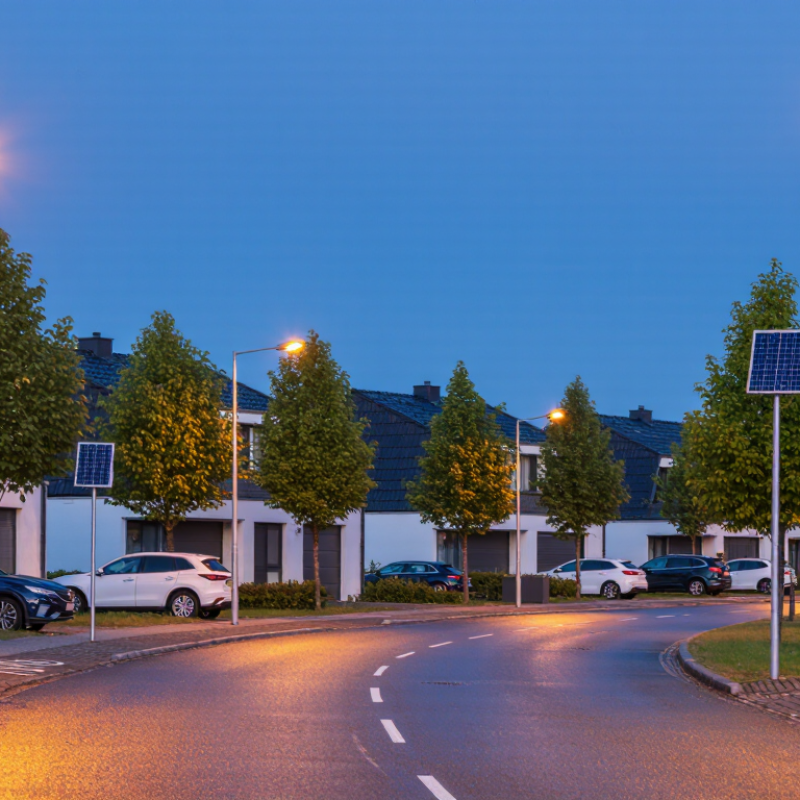
What Are Residential Street Lights and Why Do They Matter?
Residential street lights are outdoor fixtures designed for roads, sidewalks, driveways, and shared entrances after sunset. They illuminate practical spaces around homes. Unlike decorative garden lamps, they must provide consistent visibility during changing weather. Their purpose is to help drivers notice pedestrians, curbs, obstacles, and parked vehicles. Good lighting can reduce dark corners, but it cannot prevent every incident. That distinction matters. A suitable fixture usually combines controlled brightness, a durable housing, and efficient energy use. Warm or neutral white light often feels comfortable near bedrooms and living rooms. Very cool light may improve contrast, yet it can appear harsh and disturb nearby residents.
In residential projects, I examine mounting height, road width, tree growth, and nearby windows. A light that looks bright on paper may leave the pavement unevenly lit. Glare matters. It can shine into a bedroom or hide a cyclist’s silhouette from a driver. Shielding and accurate beam distribution are often more useful than simply increasing wattage. Look for weather resistance, stable controls, replaceable parts, and accessible maintenance points. Solar units can suit remote paths, but winter shade and cloudy weeks require careful planning. Motion sensors save energy in some locations, although frequent switching may annoy residents. I once focused too much on brightness and overlooked maintenance access. No design is perfect. That mistake made a small repair unnecessarily difficult. Local road rules and electrical requirements should also guide the final choice.
7 Best Street Lights for Residential Areas: How to Choose?
Residential street lights improve visibility, pedestrian safety, and nighttime comfort. LED fixtures usually provide the longest service life and high energy efficiency, while the best choice also depends on light distribution, glare control, color temperature, and maintenance needs.
Typical service-life values shown are representative industry ranges and may vary by fixture design, operating conditions, and maintenance practices.
Seven Best Street Light Types for Residential Areas
Seven Best Street Light Types for Residential Areas
The seven strongest options are cobrahead LED, full-cutoff LED, solar LED, smart adaptive LED, decorative post-top, bollard, and hybrid solar-wind lights. Cobrahead LED fixtures suit longer roads and provide broad, even coverage. Full-cutoff models direct light downward, reducing glare into bedroom windows. Solar LED units work well on lanes without reliable wiring, but winter shading can reduce output. Smart adaptive LED lights dim during quiet hours and brighten when movement is detected. Decorative post-top fixtures fit older neighborhoods, while bollards suit short paths and shared entrances. Hybrid solar-wind systems can support isolated spaces, though their maintenance needs are often underestimated.
Selection should begin with road width, mounting height, pedestrian activity, and local lighting rules. The Illuminating Engineering Society’s RP-8 guidance emphasizes visibility, uniformity, glare control, and pavement conditions. These details matter more than appearance. A 2023 U.S. Department of Energy review reports that LED lighting can reduce energy use by up to 75% compared with conventional sources. That saving depends on correct controls and optical design. More lumens do not automatically mean better safety.
In field planning, I would choose full-cutoff LED for most residential roads, smart controls for larger communities, and solar LED for remote sections. The choice is not perfect. Trees, fog, snow, and weak batteries can change performance. A trial installation on one block can reveal uncomfortable shadows before wider construction begins. Measure nighttime brightness, resident feedback, and energy use after installation. Then adjust the design.
Key Features to Compare Before Choosing a Street Light
Choosing a residential street light starts with the road, not the fixture. Walk the site after sunset. Note dark corners, tree canopies, driveway entrances, and nearby bedroom windows. A light that looks bright in a showroom may create harsh glare outdoors. Measure pole spacing and road width before comparing products. I have seen a small street become uncomfortable when every lamp was aimed too low. That mistake was avoidable.
Compare photometric data, not only lumen numbers. Check uniformity, beam distribution, and useful light on sidewalks. A narrow road may need a different optic from a broad junction. Choose a color temperature that supports visibility without making homes feel overly exposed. Lower blue content is often more comfortable at night. Look for sealed housings, corrosion resistance, and suitable IP and impact ratings. Check surge protection, dimming options, photocells, and motion controls. Controls can reduce energy use, but poor settings may leave pedestrians in sudden darkness.
Maintenance deserves equal attention. Ask how the driver, lens, and control parts can be replaced. A long rated life means little if repairs require special equipment. Review warranty terms, test reports, electrical safety compliance, and local lighting limits. Estimate energy costs from actual operating hours, not ideal claims. Keep a simple record of failures and glare complaints after installation. It may reveal that the brightest setting was unnecessary. No checklist is perfect. Weather, foliage, and community habits can change the result. Get a licensed professional to verify wiring, pole loading, and final aiming before use.
How to Select the Right Street Light for Your Neighborhood
Choosing the right street light for a neighborhood starts with the street, not the product.
Observe sidewalk width, tree cover, traffic speed, nearby windows, and nighttime activity. A quiet lane may need shielded, low-glare LED lighting. A collector road may require higher-output fixtures, stronger poles, and wider spacing. The seven practical choices include full-cutoff LED, decorative LED, solar LED, adaptive LED, pedestrian-scale lighting, low-glare lighting, and smart-controlled lighting.
Illumination should follow recognized guidance. IES RP-8-18 recommends evaluating road classification, pedestrian conflict, pavement reflectance, and surrounding brightness. The U.S. Department of Energy reports that LED street and area lighting projects often achieve energy savings of 50% or more, depending on controls and existing equipment. Efficiency alone is not enough. Excessive brightness can create glare, dark adaptation problems, and unwanted light inside bedrooms.
Ask for photometric files before approval. Check maintained illuminance, uniformity, glare ratings, color temperature, and mounting height. For many residential streets, warmer light near 2700–3000K can feel less harsh, although local conditions matter. Dark-sky guidance also favors fully shielded fixtures that send light downward. Some streets need less light. That is easy to overlook. A small test installation can reveal shadows beneath trees, reflections on parked cars, or poor visibility at crossings. Field audits often expose these details better than a polished specification sheet. The choice should also consider cleaning access, driver replacement, pole loading, warranty terms, and future control-system compatibility.
Installation, Maintenance, and Long-Term Cost Considerations
7 Best Street Lights for Residential Areas: How to Choose?
Installation decides whether a good street light performs well. Choose full-cutoff LED, adaptive LED, solar-hybrid, low-glare, corrosion-resistant, smart, or retrofit designs. A qualified installer should check pole spacing, mounting height, beam angle, cable capacity, drainage, and nighttime visibility. Photometric software can reveal dark patches before concrete is poured. That step is often skipped.
The U.S. Department of Energy’s Energy Savings Forecast of Solid-State Lighting estimates LED adoption could save 6.4 quads of energy annually by 2035. The International Energy Agency also reports that lighting uses about 15% of global electricity. These figures support efficient luminaires, but they do not guarantee low project costs. Controls, batteries, trenching, permits, and labor may dominate the budget. A lower purchase price can become expensive after repeated repairs.
Maintenance needs practical planning. Select housings with strong ingress protection, replaceable drivers, surge protection, and documented lumen-maintenance testing. DOE guidance explains that LED lifetime should consider lumen depreciation and component failure, not only advertised operating hours. Inspect lenses for dust, seals for cracking, and poles for corrosion at least annually. Clean optical surfaces when output drops visibly. Keep spare drivers and connectors on site.
I would compare total cost over 10 to 15 years. Include energy, inspections, traffic control, replacement labor, recycling, and software fees. Solar systems may reduce trenching, but winter shading and battery aging can disappoint. Perfect forecasts are rare. A small pilot on two streets can expose glare, weak coverage, or maintenance problems before full installation.
7 Best Street Lights for Residential Areas How to Choose? - Installation, Maintenance, and Long-Term Cost Considerations
| Street Light Type |
Best Residential Application |
Typical Power |
Typical Efficacy |
Estimated Installed Cost* |
Annual Energy Cost** |
Maintenance Interval |
Expected Service Life |
Estimated 10-Year Cost*** |
Key Selection Considerations |
| Full-Cutoff LED Cobrahead |
Residential roads, intersections, and existing utility poles |
40–100 W |
120–170 lm/W |
$450–$1,100 |
$39–$99 |
Visual inspection every 1–2 years |
12–20 years |
$1,000–$2,500 |
Choose a full-cutoff optic to reduce glare, light trespass, and upward light. Confirm pole compatibility and roadway illumination requirements. |
| All-in-One Solar LED |
New developments, remote streets, and areas where trenching is expensive |
20–60 W LED |
120–180 lm/W |
$1,800–$4,500 |
$0–$10 |
Clean panel every 6–12 months; inspect battery annually |
LED: 12–20 years; battery: 6–10 years |
$2,100–$5,400 |
Check solar access, winter sunlight, battery capacity, wind loading, and nighttime dimming schedules. Battery replacement is the main long-term cost. |
| Decorative LED Post-Top |
Neighborhood entrances, sidewalks, parks, and low-speed residential streets |
30–80 W |
90–140 lm/W |
$550–$1,400 |
$30–$79 |
Clean lens and inspect seals every 1–2 years |
12–18 years |
$900–$2,300 |
Provides an attractive appearance but may have less optical control than roadway fixtures. Verify wind resistance and pole-top dimensions. |
| LED Shoebox Area Light |
Residential parking areas, shared driveways, courts, and community facilities |
60–150 W |
120–170 lm/W |
$650–$1,600 |
$59–$148 |
Inspect optics, photocell, and mounting hardware every 1–2 years |
12–20 years |
$1,200–$3,000 |
Select asymmetric optics for broad area coverage and a shielded design to prevent light from entering nearby homes. |
| Dimmable LED with Motion or Network Controls |
Quiet streets where lower overnight lighting and energy savings are priorities |
40–100 W |
120–170 lm/W |
$700–$1,600 |
$26–$69 |
Test controls and photocells annually |
10–18 years |
$1,100–$2,600 |
Use a professionally configured dimming profile. Maintain minimum lighting levels required by local safety standards and provide manual override capability. |
| LED Bollard or Pathway Light |
Sidewalks, walking paths, entrances, and pedestrian-only residential areas |
10–30 W |
70–130 lm/W |
$300–$900 |
$10–$30 |
Clean lens and check damage every 6–12 months |
10–15 years |
$500–$1,400 |
Not intended to replace roadway lighting. Choose vandal-resistant construction, safe mounting height, and downward-directed illumination. |
| LED Wall-Pack or Building-Mounted Light |
Alleys, service lanes, building edges, and small residential access areas |
20–60 W |
100–150 lm/W |
$250–$800 |
$20–$59 |
Clean lens and test photocell every 1–2 years |
10–18 years |
$500–$1,500 |
A cost-effective option where a suitable building is available. Use a full-cutoff shield and verify wall strength, wiring condition, and emergency access requirements. |
Cost assumptions: Costs are indicative U.S. residential-project ranges in 2025–2026 and exclude new poles, major trenching, utility upgrades, permits, taxes, and unusual site work. Actual prices vary with mounting height, access, labor rates, climate, and local electrical requirements.
Energy calculation: Annual energy costs assume 12 hours of operation per night, 4,380 operating hours per year, and an electricity rate of $0.15 per kWh. Solar fixtures assume minimal grid electricity.
How to choose: For most residential roads, start with a full-cutoff LED fixture matched to the required illuminance and pole spacing. Consider solar LED where grid connection costs are high, adaptive controls where overnight traffic is low, and decorative or pathway fixtures only where their optical performance meets the required pedestrian-safety level.
FAQS
Full-cutoff LED lights suit many residential roads. They direct light downward and reduce glare into bedroom windows. Check road width and pole spacing first. More brightness is not always safer.
Cobrahead fixtures work well on longer roads. Their broad beam can cover wider pavement evenly. They may feel excessive on short, narrow lanes. Confirm the optical design before installation.
Solar LED lights suit lanes without reliable wiring. They can operate independently from the main electrical network. Winter shade, snow, and weak batteries may reduce output. Performance can disappoint.
Smart adaptive lights dim during quiet hours. They brighten when movement is detected. Poor settings may leave pedestrians in sudden darkness. Test brightness near crossings and driveways.
Decorative post-top fixtures suit older-looking neighborhoods and pedestrian areas. They can support a traditional streetscape. Appearance should not outweigh glare control. Check whether nearby windows receive unwanted light.
Bollard lights suit short paths and shared entrances. They provide pedestrian-scale lighting near sidewalks. They may not illuminate roadways effectively. Place them carefully beside trees and steps.
Walk the area after sunset. Note dark corners, tree canopies, driveways, and bedroom windows. Review beam distribution, uniformity, glare, mounting height, and energy use. Lumen numbers alone can mislead.
A one-block trial can reveal harsh shadows and reflections on parked cars. Measure nighttime brightness, resident feedback, and energy use. Weather and foliage can change the result. The first design may need revision.
Conclusion
Residential street lights play an important role in improving nighttime visibility, pedestrian safety, traffic awareness, and the overall comfort of a neighborhood. This guide reviews seven suitable options, including LED street lights, solar-powered fixtures, decorative lanterns, post-top lights, motion-sensor lights, smart lighting systems, and low-glare pathway lights. Each type offers different benefits in brightness, energy efficiency, appearance, control, and installation flexibility.
To understand how to choose street lights for residential areas, compare key features such as light distribution, color temperature, weather resistance, operating costs, maintenance needs, and compatibility with existing infrastructure. Consider the street layout, local climate, traffic levels, surrounding homes, and the needs of pedestrians and drivers. Proper planning should also include installation height, spacing, wiring or solar placement, future repairs, and long-term energy consumption. A well-selected lighting solution can provide reliable illumination, reduce unnecessary glare, control costs, and create a safer, more pleasant residential environment.

 Star Lighting