How does weather affect street light performance? This question matters wherever lighting must remain dependable through rain, heat, snow, dust, and coastal air. A streetlight is not simply a lamp on a pole. It is an electrical, optical, thermal, and control system exposed every night.
Lighting engineer James R. Benya has noted, “Outdoor lighting must be designed for the environment in which it operates.” This principle explains why identical fixtures can perform differently across cities. Rain may collect inside poorly sealed housings, while condensation can corrode terminals and dim connections. Fog scatters light, reducing contrast on wet pavement. Snow can cover lenses or reflect excessive glare toward drivers. Salt carried by coastal wind is especially aggressive. It slowly attacks metal fittings, gaskets, and circuit boards.
Temperature creates another challenge. LEDs usually operate efficiently, yet extreme heat can shorten driver life when heat sinks cannot release warmth. Sudden cold may harden seals and expose weak joints. Wind adds vibration, especially on tall poles with loose brackets. Small faults become visible through flickering, delayed start-up, or uneven brightness.
A practical assessment should examine IP ratings, surge protection, thermal design, drainage, and maintenance records. Infrared inspections can reveal overheated components before failure. Field testing after storms is valuable, too. Still, weather is not the only cause. Poor installation, aging wiring, and unsuitable controls may share responsibility. That distinction is easy to miss.
The best answer to “How does weather affect street light performance” depends on local evidence, not assumptions. Durable lighting begins with climate-aware design and honest, repeated inspection.
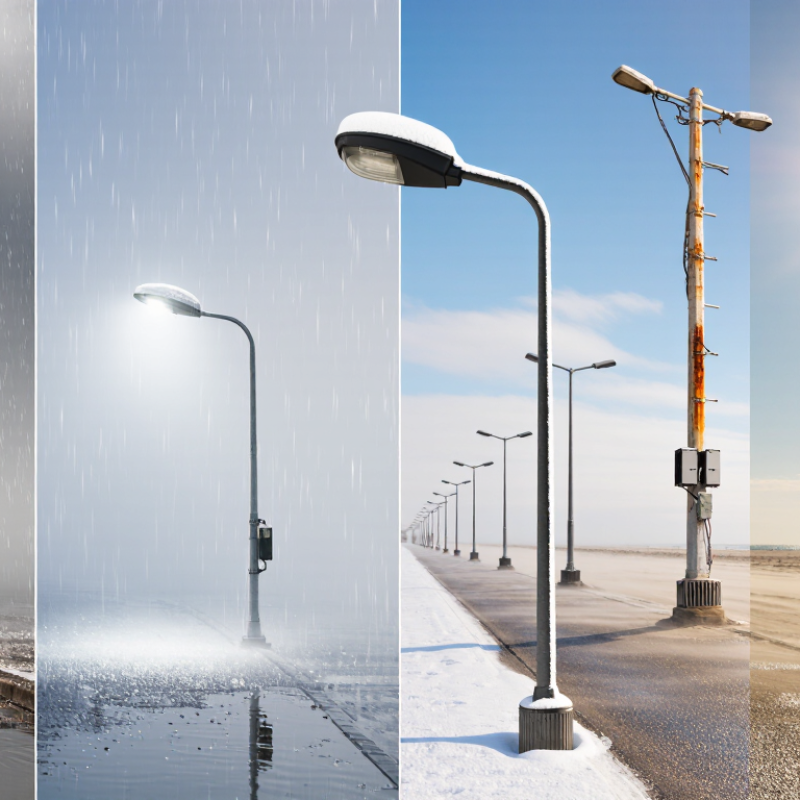
Weather Conditions That Influence Street Light Performance
How Does Weather Affect Street Light Performance?
Rain changes more than visibility. Water droplets scatter and absorb light, while wet pavement creates sharp reflections that can increase glare. The CIE 115:2010 road-lighting standard evaluates maintained illuminance, not merely initial output. That distinction matters because dirt, moisture, and aging reduce useful light over time. Field inspections often find cloudy lenses after storms. Small seals can fail first.
Fog is more disruptive.
Suspended droplets spread light near the fixture, creating a bright halo and reducing contrast for drivers and pedestrians. Snow adds another problem. A thick layer can cover the optical surface, while snow-covered roads reflect light differently from dry asphalt. The U.S. Federal Highway Administration’s Road Weather Management Program links precipitation and reduced visibility with higher driving risk, although lighting alone cannot correct unsafe speeds.
Temperature affects electronics and batteries.
The U.S. Department of Energy’s 2020 Solid-State Lighting R&D Plan identifies thermal management as essential for maintaining LED performance, with 200 lumens per watt listed as a research benchmark. Actual street fixtures operate below laboratory results because heat, drivers, optics, and weather interact. Wind may cool a housing, but it can also loosen hardware. Humidity accelerates corrosion, especially near salted roads. CIE 154:2003 advises including environmental conditions in maintenance planning. That guidance is useful, but not perfect. Local exposure still needs measurement.
How Temperature Changes Lighting Efficiency and Equipment Operation
How Does Weather Affect Street Light Performance?
Temperature strongly influences lighting efficiency and street light operation. Cold air can improve LED output, but it may reduce battery capacity and increase startup delays. Heat creates a different problem. Excessive warmth raises component temperatures and can shorten driver life. It may also reduce light output when thermal protection activates.
In field inspections, I have seen fixtures appear normal during cool mornings but dim after several hot hours. The surrounding pavement can hold heat long after sunset. Wind helps release heat, while enclosed housings may trap it. Temperature changes also cause repeated expansion and contraction. Over time, seals, wiring connections, and circuit boards may weaken. These effects are easy to miss during a single inspection.
Tips: Check light output at different times. Record ambient and housing temperatures. Keep ventilation paths clear. Inspect seals after seasonal changes. Use a calibrated light meter when possible. Simple observations help, but they are not enough.
Cold weather can also affect photocells, control units, and backup power systems. Moisture may form when warm air meets a chilled enclosure. That condensation can create unstable operation or corrosion. A useful maintenance plan should compare seasonal readings, not rely on one visit. I once underestimated heat buildup because the fixture looked clean from outside. The internal temperature told a less comfortable story. Engineers should allow for local climate, installation height, surface materials, and daily temperature cycles. These details often matter more than the weather forecast alone.
The Effects of Rain, Snow, and Humidity on Street Light Components
How Does Weather Affect Street Light Performance?
Rain, snow, and humidity challenge street lights in different ways. Water can enter through seals, cable glands, or tiny housing gaps. Once inside, it may corrode terminals and create unstable electrical connections. The IEC 60529 standard uses IP ratings to classify protection against water and dust, but an IP rating is not a promise of permanent protection. Aging seals still deserve inspection.
Snow creates another problem.
Wet snow can collect on lenses, reducing light output and changing the intended beam pattern. Freeze-thaw cycles are especially harsh because trapped water expands inside small cracks. The U.S. Department of Energy’s Solid-State Lighting research repeatedly identifies thermal management as a major factor in LED reliability. A cold night may improve electronic efficiency, yet repeated moisture and temperature changes can damage supporting components.
Humidity is quieter but persistent. The Illuminating Engineering Society’s LM-80 and TM-21 methods measure LED lumen maintenance under controlled conditions, not in constantly damp streets. Field performance can therefore differ from laboratory projections. In coastal areas, salt-laden moisture may accelerate corrosion, even when rainfall is limited. A 2023 U.S. Department of Energy SSL R&D plan also lists reliability and environmental durability as continuing research priorities.
In practice, technicians should check condensation marks, cloudy lenses, loose gaskets, and discolored connectors. I would not trust brightness alone. A light can appear normal while moisture is already weakening its internal connections.
How Wind, Storms, and Extreme Weather Cause Structural Damage
How Does Weather Affect Street Light Performance?
How Wind, Storms, and Extreme Weather Cause Structural Damage
Weather affects street lights through forces that are easy to underestimate. Strong wind presses against the pole, arm, and luminaire like a moving wall. Gusts create repeated bending around the base plate and anchor bolts. A small crack may widen after several storms. Salt spray and standing water can accelerate corrosion. Rust quietly reduces metal thickness. Then vibration increases.
Field maintenance experience shows that damage often begins at connection points. Technicians should inspect welds, fasteners, cable entries, and foundation edges. They should also check whether the pole has started leaning. After a storm, look for displaced covers, bent brackets, exposed bolts, and fresh concrete fractures. Do not rely only on nighttime operation. A lamp can still shine while its support is failing.
Flooding may wash soil away from foundations, leaving a pole poorly supported. Freeze-thaw cycles can open cracks in concrete. Hail usually affects lenses more than structure, but it may expose brittle components. Wind-load calculations should consider local wind speeds, pole height, fixture weight, and soil conditions. No inspection method is perfect. Missed damage happens during rushed emergency repairs. Better records, measured tilt checks, and repeated inspections reduce that risk.
How Does Weather Affect Street Light Performance?
Higher sustained wind speeds increase the structural load on poles, brackets, foundations, and luminaires. The reference points use official U.S. National Weather Service wind classifications: tropical-storm-force winds begin at 39 mph, while hurricane categories begin at 74 mph. At these levels, falling branches, flying debris, flooding, and lightning can also interrupt street-light operation.
Reference: NOAA/National Weather Service wind-speed classifications. Actual damage depends on pole design, exposure, installation quality, debris, and maintenance.
Weather-Resistant Designs and Maintenance for Reliable Street Lighting
Weather affects street lights through heat, rain, ice, dust, and salt carried by coastal air. Water enters through damaged seals, loose cable glands, or cracked lenses. Water finds weak points. Condensation can then corrode terminals and reduce insulation resistance. Cold weather also contracts metal parts, while heat accelerates driver aging. The U.S. Department of Energy reports that LED street lighting can reduce energy use by approximately 50–70% compared with conventional sources. However, poor thermal design can reduce those gains.
Weather-resistant design should begin with a sealed housing and suitable ingress protection. Under IEC 60529, an IP66 enclosure is dust-tight and resists powerful water jets. Higher protection may be necessary in flood-prone locations. Drainage paths still matter. A sealed fixture without pressure control can trap moisture during temperature changes. Field technicians should inspect gaskets, vents, cable entries, and lens damage after severe storms. Small details matter. The Federal Highway Administration has documented roadway lighting projects achieving roughly 40–60% energy savings after LED upgrades, but maintenance conditions strongly influence long-term performance.
Thermal paths require equal attention. The U.S. Department of Energy’s solid-state lighting research reports laboratory LED efficacies above 200 lumens per watt, yet outdoor systems operate under dirt, heat, and voltage variation. Cleaning schedules should reflect local exposure, not a fixed calendar. Coastal fixtures may need more frequent corrosion checks. Snow should be removed without scratching optical surfaces. I have seen maintenance plans overlook connector corrosion until light output visibly declines. That is an avoidable lesson. Photometric testing, insulation checks, and torque inspections provide stronger evidence than visual inspection alone. Occasionally, the simplest inspection is missed.
FAQS
Cold air may improve LED output, but batteries can lose capacity. Startup delays may also increase. Check morning operation carefully.
Heat raises internal component temperatures. Thermal protection may reduce light output. A fixture can look clean outside but overheat inside.
Repeated expansion and contraction can weaken seals, wiring connections, and circuit boards. Damage may develop slowly. Inspect after seasonal changes.
Measure light output during cool mornings and hot evenings. Record ambient and housing temperatures. Use a calibrated light meter when possible.
Yes. Warm air can meet a chilled enclosure and form condensation. Moisture may cause unstable operation or corrosion. Look for damp surfaces.
Wind pushes against poles, arms, and luminaires. Repeated gusts bend base plates and anchor bolts. Small cracks can widen over time.
Check welds, fasteners, cable entries, foundation edges, and pole alignment. Look for bent brackets, displaced covers, exposed bolts, and concrete fractures. Do not inspect only at night.
Floodwater may wash soil from around the foundation. Freeze-thaw cycles can open concrete cracks. Measure pole tilt and keep repeated inspection records.
Yes. The lamp may shine while its support weakens. I might miss damage during a rushed inspection. Look closer.
Conclusion
How does weather affect street light performance? Temperature, moisture, wind, and severe weather can all influence how effectively street lights operate. High temperatures may reduce lighting efficiency, shorten component life, and affect electrical performance, while freezing conditions can make materials brittle and delay startup. Rain, snow, and humidity may enter fixtures, encourage corrosion, create condensation, and reduce visibility through water or ice buildup on lenses. These conditions can also increase maintenance needs and cause intermittent or complete lighting failures.
Strong winds and storms may loosen poles, damage wiring, or shift fixtures away from their intended lighting direction. Reliable street lighting therefore depends on weather-resistant designs, sealed housings, corrosion-resistant materials, secure foundations, and suitable drainage. Regular inspections are equally important, especially after extreme weather. Cleaning lenses, checking connections, removing snow or debris, and repairing structural damage promptly can help maintain consistent illumination, improve safety, and extend the service life of street light equipment in changing climates.

 Star Lighting